


 Cart
Cart
 sales@molnova.com


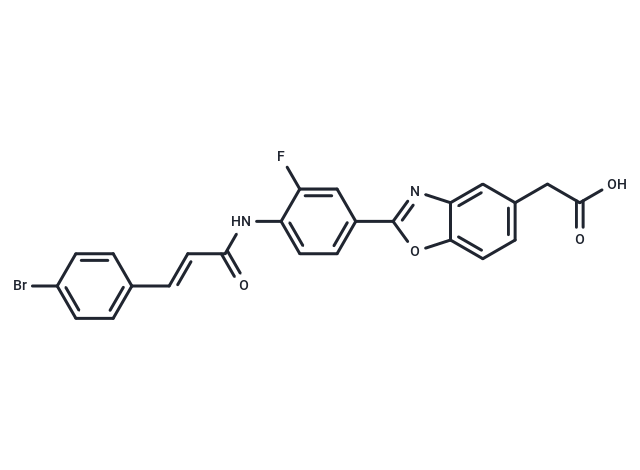
OGT 2115
CAS No. 853929-59-6
OGT 2115( —— )
Catalog No. M33446 CAS No. 853929-59-6
OGT 2115 is an inhibitor of heparanase (IC50 = 0.4 μM), an enzyme that cleaves heparan sulfate into glucuronic acid (GlcUA) and N-acetylglucosamine (GlcNAc).
Purity : >98% (HPLC)
 COA
Datasheet
HNMR
HPLC
MSDS
Handing Instructions
COA
Datasheet
HNMR
HPLC
MSDS
Handing Instructions
| Size | Price / USD | Stock | Quantity |
| 2MG | 46 | Get Quote |


|
| 5MG | 67 | Get Quote |
|
| 10MG | 119 | Get Quote |
|
| 25MG | 250 | Get Quote |
|
| 50MG | 419 | Get Quote |
|
| 100MG | 605 | Get Quote |
|
| 500MG | Get Quote | Get Quote |
|
| 1G | Get Quote | Get Quote |
|
Biological Information
-
Product NameOGT 2115
-
NoteResearch use only, not for human use.
-
Brief DescriptionOGT 2115 is an inhibitor of heparanase (IC50 = 0.4 μM), an enzyme that cleaves heparan sulfate into glucuronic acid (GlcUA) and N-acetylglucosamine (GlcNAc).
-
DescriptionOGT 2115 is a potent, cell-permeable and orally active heparanase inhibitor with an IC50 of 0.4 μM. OGT 2115 has anti-angiogenic properties (IC50 of 1 μM). OGT 2115 also inhibits heparan sulfate degradation activity.
-
In Vitro——
-
In Vivo——
-
Synonyms——
-
PathwayOthers
-
TargetOther Targets
-
RecptorOthers
-
Research Area——
-
Indication——
Chemical Information
-
CAS Number853929-59-6
-
Formula Weight495.3
-
Molecular FormulaC24H16BrFN2O4
-
Purity>98% (HPLC)
-
SolubilityIn Vitro:?DMSO : 11.36 mg/mL (22.94 mM; Ultrasonic )
-
SMILESOC(=O)Cc1ccc2oc(nc2c1)-c1ccc(NC(=O)\C=C\c2ccc(Br)cc2)c(F)c1
-
Chemical Name——
Shipping & Storage Information
-
Storage(-20℃)
-
ShippingWith Ice Pack
-
Stability≥ 2 years
Reference
1.Courtney SM, et al. Furanyl-1,3-thiazol-2-yl and benzoxazol-5-yl acetic acid derivatives: novel classes of heparanase inhibitor. Bioorg Med Chem Lett. 2005 May 2;15(9):2295-9.?
molnova catalog



related products
-
CRANAD 2
CRANAD-2 is a difluoroboron-derivatized curcumins as near-infrared probe for in vivo detection of amyloid-beta deposits.?
-
7-hydroxycoumarinyl-...
7-hydroxycoumarinyl-γ-Linolenate is a γ-linolenic acid ester of 7-hydroxycoumarin (umbelliferone) that behaves as a substrate for cPLA2. Hydrolysis of 7-hydroxycoumarinyl-γ-linolenate by phospholipase results in the release of the fluorescent compound 7-hydroxycoumarin which can be monitored spectrophotometrically (excitation at 335 nm, emission at 450 nm).
-
EcDsbB-IN-12
EcDsbB-IN-12 targets disulfide bond forming enzyme,and is a novel potent specific inhibitor of EcDsbB.
